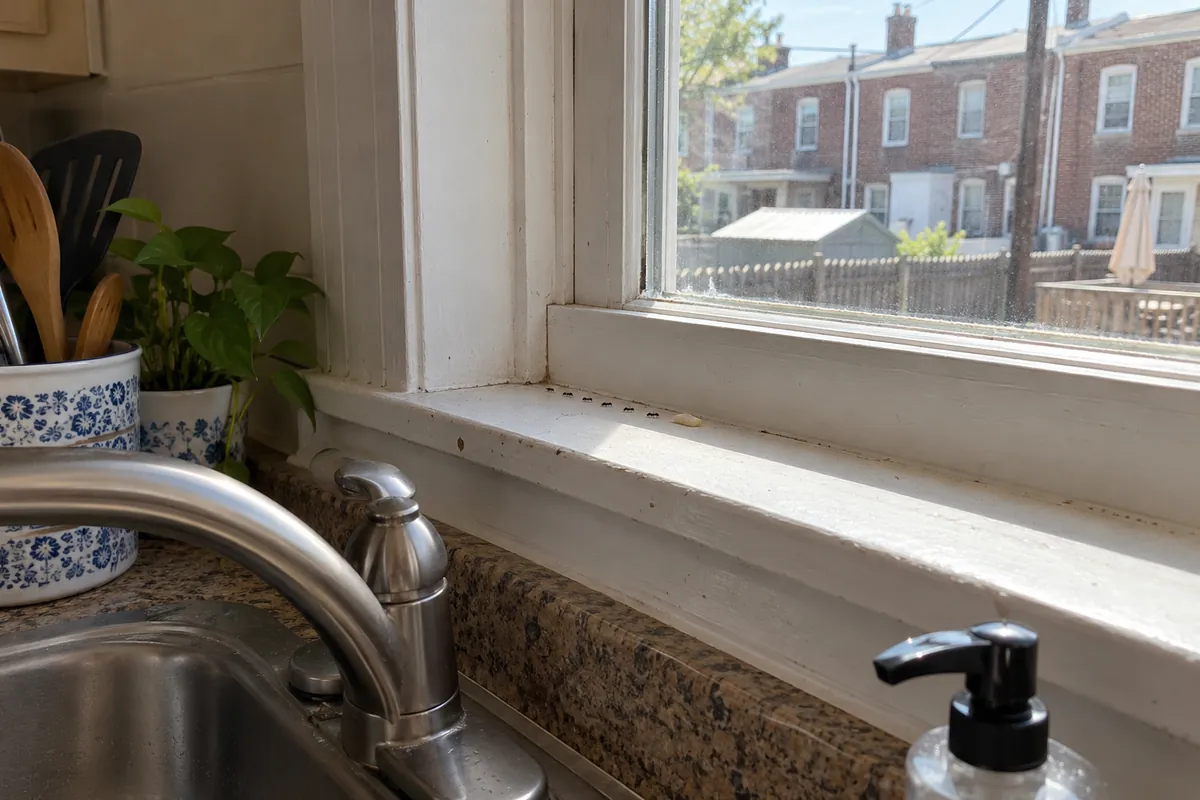
In Menifee, CA, getting rid of ants starts by working out which ant you have, since odorous house ants, pavement ants, carpenter ants and Argentine ants all react differently to treatment. A line of ants on the kitchen counter, sawdust beneath a window and a mound next to the patio each lead to a different plan. Describe where you see them through Call Now and an independent provider serving 4 ZIP codes around Menifee will answer.
Ants you are likely to find in a house
Odorous house ants
These small ants are dark brown to black and give off a smell like rotten coconut when crushed. Their large colonies settle in wall voids, beneath sinks and in landscaping, and the workers trail toward sweet foods and water.
Pavement ants
A dark brown ant that nests beneath slabs and driveways and in sidewalk cracks, pushing up little mounds of soil next to the pavement. Workers get in through cracks in the slab and haul food back to the colony.
Carpenter ants
Large ants, black or red and black, dig their galleries in damp or damaged wood. A nest nearby shows itself through coarse, sawdust-like frass piled up, faint rustling in the walls, or winged ants emerging in spring.
Argentine ants
This ant ranges from light to dark brown and builds enormous linked colonies in warm regions. It climbs walls in long lines, most visibly after rain or a dry spell.
Where ants get into the home
- Door thresholds, weather stripping and window frames
- Tree limbs, shrubs and vines that touch the roof or siding
- Gaps around plumbing under sinks and behind appliances
- Utility lines, dryer vents and AC lines entering the wall
- Cracks in the foundation and slab expansion joints
Moisture, wood and carpenter ant damage
Wood is not food for carpenter ants; they hollow it out to nest in, and wood that leaks, condensation or rot have already softened is what they choose. To find the nest, find the moisture behind it, which might be a roof leak, a window seal that is failing, a deck built against siding or a clogged gutter.
Treating the ants without fixing the water leaves the wood soft and the problem likely to return. A provider who finds the moisture source and tells you to repair it is giving you the whole answer.
Why bait beats spray for most ants
Killing the ants you can see only removes trail workers; the colony carries on. Bait that acts slowly gets taken back to the nest and shared, which cuts down the queen and brood. Gel baits and granular baits go along the trails, and a perimeter treatment using a non-repellent product puts a barrier in place outdoors.
Repellent sprays and wipes can scatter a colony into several new ones. Resist the urge to clean the trail with spray until the bait has worked.
How an ant control visit works, step by step
A good visit follows the same order every time, whatever the pest. Knowing the order helps you compare what each company offers and spot a visit that skips the first two steps.
- Inspection: the technician walks the outside first (foundation, vents, utility lines, eaves, fence lines, mulch) and then the inside (kitchen, bathrooms, garage, attic or crawl space).
- Identification: the species is named from the insect, droppings, damage or trail, because the right product and method depend on it.
- Plan: the provider explains what will be done, which products or devices will be used, and what you need to do before and after.
- Treatment or exclusion: the work is done in the places the inspection found, not by spraying every room.
- Follow-up: you get a date for the next check and a clear answer on what to report if activity returns.
Questions to ask before you agree to any ant control
- What species or problem did you find, and what did you see that proves it?
- Who is on site, and can you show the state licence or applicator ID for the work?
- What will you write down for me: scope, exclusions, follow-up and product list?
- What will you seal, remove or fix, and what stays my job?
- How many visits are in the plan, and what happens if activity returns?
- Which products, baits or devices will you use, and where will they go?
What makes ant control different in Menifee
Western Riverside County city incorporated in 2008, with Sun City Menifee (a 55-plus community), Menifee Lakes, Audie Murphy Ranch, and Heritage Lake. Many newer tract homes on former farm and ranch land; moving soil and irrigation draw ants and rodents.
Argentine ants, roof rats, drywood termites, black widows, and crickets are common Inland Empire pests. Hot, dry summers; irrigation and HOA landscaping create moisture pockets. Ask any provider how these local details change the plan for your address, because a method that works in one climate or housing style can fail in another.
Ant control across Menifee and nearby cities
These 4 ZIP codes in Menifee, California are covered by Pest Control Menifee: 92584, 92585, 92586, 92587. Requests can also be passed to providers who serve Perris, Hemet, Lake Elsinore, San Jacinto and Wildomar. Because coverage is confirmed address by address, mention your ZIP code when you phone.
To get going, press Call Now at the top of any page and tell the person who answers what you found. That puts you through to an independent provider nearby, and the provider verifies your address, looks the property over and writes up the scope.
Related help in Menifee
If this is not quite your situation, these pages cover the neighboring questions: How Pests Get Into Menifee Homes: Entry Points and Fixes; Termite Control; Cockroach Control; Mosquito Control. The service area list shows every nearby city and ZIP code covered.
Ant Control in Menifee: common questions
How many visits does ant control take?
One visit plus a follow-up check can be enough for a straightforward ant problem. When trails keep appearing, there are several colonies or carpenter ants are involved, expect more visits. The provider should lay out the plan and say what would bring them back.
How do I tell carpenter ants from other ants?
Size is the first clue, because carpenter ants are noticeably bigger, often longer than a quarter inch, and they leave coarse frass like sawdust close to wood. Faint rustling may be audible in the walls. A technician can confirm the ant and trace the moisture that drew them in.
What kills the ant colony, not just the ants I see?
Foragers carry slow-acting bait home to the nest, which makes it the most reliable way to affect the colony. A spray kills just the ants it touches and can split the colony apart.
Why do I keep seeing ants in my kitchen?
Ants follow scent trails to food and water. Crumbs, pet food, sticky spills and a damp area under the sink are common attractions. Cleaning removes the reward but does not remove the colony, so baiting and sealing the entry points are needed.
Are ants a sign of a dirty home?
No, ants do not mean the house is dirty. What they are after is food, water and shelter, all of which clean homes can supply too, and heavy rain or high heat frequently pushes colonies inside.
Are ant baits safe around pets and children?
Only small amounts of bait are used, set inside stations or pushed into cracks so that exposure stays low, but bait remains a pesticide. Find out where it will be placed, keep children and pets well away from it, and follow what the label says.